Last updated: 3rd December 2024
Wiring, Thick and Thin
We received an enquiry via the Club website from an enthusiast in Canada who was in the process of rewiring his 'Seven'. He was hoping to use the existing wire sizes as a guide but unfortunately the previous owners seemed to have used whatever wire which came to hand. He had a circuit diagram but no colours or wire sizes were indicated and as he was not an electrical expert he was having trouble sizing the wires.
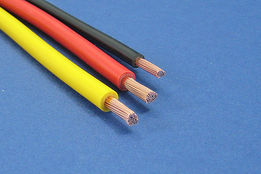
It certainly wasn’t a daft question at all. Wire sizing is a
mixture of the number of strands in any one wire, the thickness of any
one strand in mm and the total cross sectional area in square mm.
I blatantly plagiarise Auto Electric Supplies' website, (http://www.autoelectricsupplies.co.uk/product/66/category/11) as it is both accurate and informative.
“Standard Cable
General purpose low voltage cable for use in
automotive and marine applications in temperatures up to 70 deg C.
Consists of conductors of stranded copper wire which are PVC insulated.
Cable descriptions give the number and size of cable strands and the
total cross-sectional area of conductor. For example 14/0.30, 1.0mm2
refers to 14 strands of 0.30mm diameter cable giving a total cable
conductor area of 1.0mm2. Where two colours are indicated (eg.
Blue/Black), the first is the main colour and the second is the tracer
colour.
Typical Uses:
9/0.30 : Side/tail lamps, indicators etc.
14/0.30 (010102): Side/tail lamps, indicators, fog lamps,
general wiring.
28/0.30 (010103): Head lamps, wipers, screen heaters,
petrol pumps, etc.
44/0.30 (010104): Charging circuits, main feeds.
65/0.30 (010105): Heavy duty charge circuits, alternator feeds.
84/0.30
(010106), 97/0.30 (010107), 120/0.30 (010108) & 80/0.40 (010109) Heavy
duty charge circuits, alternator and battery feeds.”
Now, for your 'Seven', you can be a little more penny pinching with
wire types if you have converted to 12V, simply because the current
(Amperage) of each load will be lower than the same load for 6V.
Remember that 6V systems suffer worse for drops and losses than 12V.
Therefore, use the “typical uses” table, but if you are still using 6V,
choose one wire size thicker than stated.
You don’t really have any very heavy feeds, (other than the starter
motor!) so you won’t need anything thicker than 44/0.3 even for the
biggest cable, (being dynamo to D terminal, cutout A terminal to
ammeter, ammeter to battery. )
So, in a nutshell
Typical Wiring |
||
| Type | Manufacturer's stated continuous Current | Usage |
| 9/0.3 0.65mm2 |
5.75A | All the lights except the headlight; dynamo
F circuits, petrol gauge, trafficators. If you want to save a watt or two, consider LED tail lights. |
| 14/0.3 1.0mm2 |
8.75A | OK for the headlights provided they are wired separately, (not like a Christmas tree!) |
| 28/0.3 2.0mm2 |
17.5A | For charging circuits 12V ONLY (Battery to
ammeter B terminal, ammeter to cutout A, cutout D to dynamo D) Also for headlights feed to a floor mounted dipswitch (such as on a Ruby) or relay |
| 44/0.3 3.7mm2 |
27A | For charging circuits 6V. (Battery to
ammeter B terminal, ammeter to cutout A, cutout D to dynamo D) Of course, if you fancy a heated rear screen ..... |
I hope this helps. Oh, one last tip, there is a sort of standard for wiring colours that is shown in the “Companion”. Keeping to it (or something like it) makes fault finding easier!. Resist the temptation to buy a large reel of one colour!!
This article, by Geoff Hardman, originally appeared in Seven Focus, March 2012 pp28-29
See also:
Wires and Terminals - How to ensure their electrical efficiency