Last updated: 1st December 2024
Ruby goes to Japan
OK first made contact with Doug Castle through the website in July
2010. OK had purchased a Ruby via ebay that had a CA7C sticker on the
windscreen and wondered whether we could give him any history of the
car. The car had belonged to Tracy and Stephan Espin at Launceston and
had been sold to a local garage who subsequently advertised it on ebay.
We keep in contact with OK and email him a copy of FOCUS each month.
This month we invited him to tell us a little about himself and the cars
new life.
 Hi, first I will introduce myself. My name is Ikuo Okano and I live in
Shiga which is on the east side of Kyoto, Japan. I’m 51 years old and am
an engineer. I was very pleased to be asked to write an article.
I like small cheap cars for 3 reasons. They are easy and cheap to
maintain and fun to drive. Modern cars are difficult to maintain because
of their CPUs, sensors and crowded engine bays. Old cars are very
simple. I can maintain them using manuals and cheap tools! Especially
British cars because many parts are easily obtained. Of course I don’t
dislike Rolls Royse or Bentley cars but I can’t drive them to do daily
shopping, nor go to my office. However I can use an Austin or an MG
every day without consideration. In August 2009, my friend Nishio,
who has restored some pre-war cars said to me that an Austin Seven is
interesting and their price was reasonable. We could get parts to repair
them on the internet and maintain them ourselves. I had an interest in a
pre-war car so I studied about Austin Sevens.
Hi, first I will introduce myself. My name is Ikuo Okano and I live in
Shiga which is on the east side of Kyoto, Japan. I’m 51 years old and am
an engineer. I was very pleased to be asked to write an article.
I like small cheap cars for 3 reasons. They are easy and cheap to
maintain and fun to drive. Modern cars are difficult to maintain because
of their CPUs, sensors and crowded engine bays. Old cars are very
simple. I can maintain them using manuals and cheap tools! Especially
British cars because many parts are easily obtained. Of course I don’t
dislike Rolls Royse or Bentley cars but I can’t drive them to do daily
shopping, nor go to my office. However I can use an Austin or an MG
every day without consideration. In August 2009, my friend Nishio,
who has restored some pre-war cars said to me that an Austin Seven is
interesting and their price was reasonable. We could get parts to repair
them on the internet and maintain them ourselves. I had an interest in a
pre-war car so I studied about Austin Sevens.
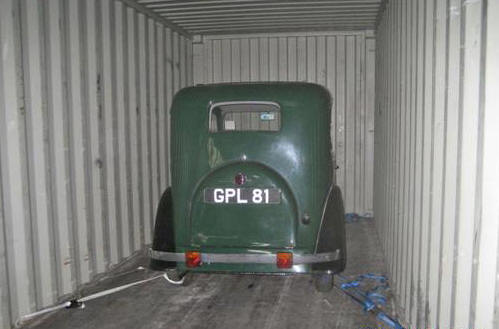
I searched for an Austin Seven on ebay. I liked best an RN on initial
looking. I wanted to use it daily. The Ruby has auto advance ignition
and synchromesh on second gear. It would be easier to drive than an RN.
So that decided it. After about a month I found a good condition
Ruby and bid for it. CA7C members may know the car well.
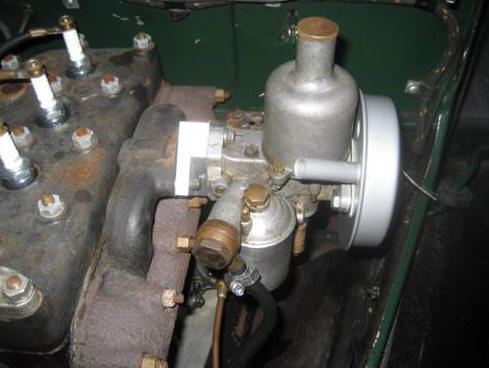
I asked Mr Nishio to import it for me. He is not a professional dealer
but had imported many cars from England. I collected the car from Kobe
port in November 2009. The first time I tried to start the engine
it wouldn’t run. I found petrol leaking from the carburettor. I
dismantled it but couldn’t find out the problem or understand how it
worked! I thought an SU carburettor would be better than a Zenith. I
searched for and found a 11/8 SU on ebay. I fitted the SU and the
car started easily, I was very pleased.
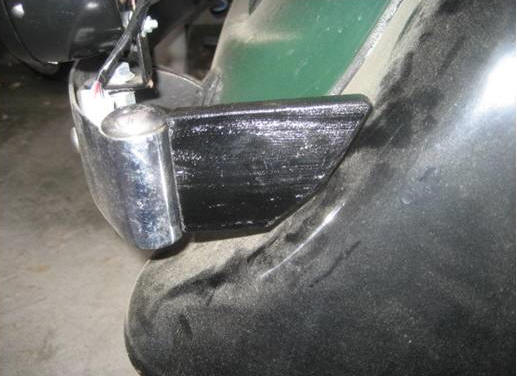
I had to have the car registered in Japan. Japanese registrations have
many requirements. Examples are head light brightness, winker lens must
be more than 20 sq cm and diameter must be more than 51 mm. The
clearance between the body and the bumper must be less than 20cm. There
were many other requirements.
The headlights were too dim and I wanted to use the car daily as well as
for events. So I decided to change from 6V positive earth to 12V
negative earth. The technical articles on CA7C’s website were very
useful to me. My headlights are now 35/35W halogens.
I use my car three or four days a week. I go shopping, go training and
go to the office. I drove 860 miles during four months of last year. I’m
sure the car cannot run as well as a new car. The brakes are poor and as
I start from the lights I hold up other cars. But it is fun for me to
drive! People that I don’t know speak to me. What is the name of
the car? What capacity is the engine? When was the car made?
I answer them with pleasure. In Japan we only see pre-war cars in
events. My Austin Seven is very unusual even for someone who has little
interest in cars. My fiends in the office or neighbourhood say that they
like the colour and that it is very cute. Some of them ask for a ride in
it!
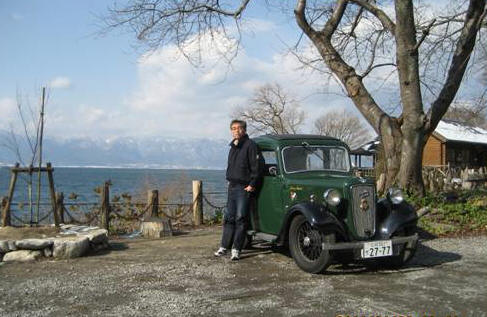 By the way, there are 3 men who own an Austin Seven near me. One has a
Tourer and the other two have Nippies.
By the way, there are 3 men who own an Austin Seven near me. One has a
Tourer and the other two have Nippies.
On of the men is only 19 years old! He is restoring it. Another man who
is a university student bid on an Ulster last November and it is now on
a ship coming from the UK. When it gets to Japan he will be the
5th man. You think there are some strange people in Japan don’t you?
I’d like to thank all the readers of my article. Best wishes to everyone
from Japan.
This article, written by Ikuo Okano, originally appeared in Seven Focus
February 2011 pp10-11.
OK lives to the south-west of Tokio and was not directly affected by the
earthquake and tsunami in March 2011.
Our Magazine Editor, Geoff Hardman, goes to Japan regularly with his
work. The office is about 30 miles from OK's home and so with a
free weekend Geoff was able to meet OK on 30 January 2011 and enjoy a
day with him and his friend.
A perfect Austin Sunday
So, what’s your idea of a perfect Austin Sunday? Take a ride along
the coast? Spend some time getting greasy under someone else’s
car? Visit a castle or a special historic site? Or maybe just a
nice cup of tea with friends?So, what’s your idea of a perfect Austin Sunday? Take a ride along
the coast? Spend some time getting greasy under someone else’s
car? Visit a castle or a special historic site? Or maybe just a
nice cup of tea with friends?
Yep, me too. So I was very fortunate to do all these things on the last
Sunday in January. The difference being that I was just over 6000 miles
from home.
Remember last month, when Mr Okano, (OK to his friends), sent us some
pictures of his Ruby? Well, as I had, most unusually, a free weekend in
Japan on my own, a couple of emails later I had a trip all planned up.
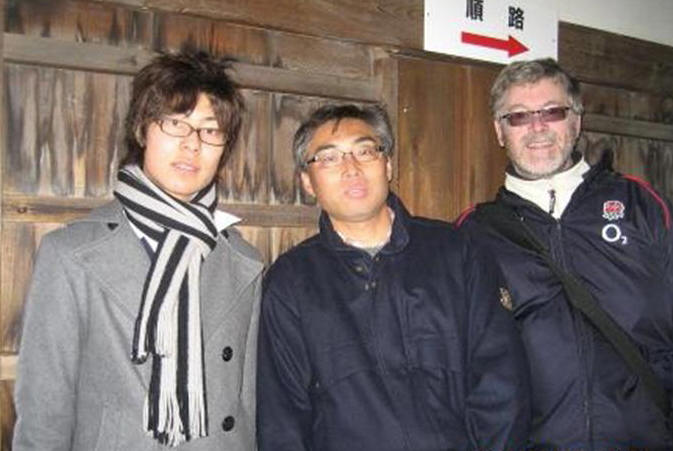 OK lives about an hour by express train northeast of Osaka, at
Ohmihachiman on the shores of Lake Biwa. This isn’t a lake Stithians
style, this is the biggest lake in Japan, with magnificent mountains
surrounding it. Thanks to an icy blast from
Northern China, they also had a good 8” of snow! OK met me at the
station, where we also met his friend, Mr Sugimoto, who joined us for
the day.
OK lives about an hour by express train northeast of Osaka, at
Ohmihachiman on the shores of Lake Biwa. This isn’t a lake Stithians
style, this is the biggest lake in Japan, with magnificent mountains
surrounding it. Thanks to an icy blast from
Northern China, they also had a good 8” of snow! OK met me at the
station, where we also met his friend, Mr Sugimoto, who joined us for
the day.
Parked outside the station was OK’s Ruby. You remember, it used to live
in Launceston! Looking absolutely splendid with a lovingly applied
polish, the Ruby is in tip top fettle. There’s a couple of basic
reasons. The Ruby is OK’s pride and joy, and he drives it very
regularly. Actually, every day, as he uses it for his 5 mile commute to
work. Far enough to get everything warmed up, and often enough that
nothing seizes and every foible is dealt with promptly. He had to do two
modifications to be allowed to use it in Japan; the bumper had to be
moved closer to the rear wings and the indicators had to be upgraded. In
addition, OK has added some simple lap seat belts from floor anchors.
Not essential, but he feels much safer with them fitted. In the typical
Japanese drive for efficiency, it now sports 12V electrics with LEDS for
every light except the heads.
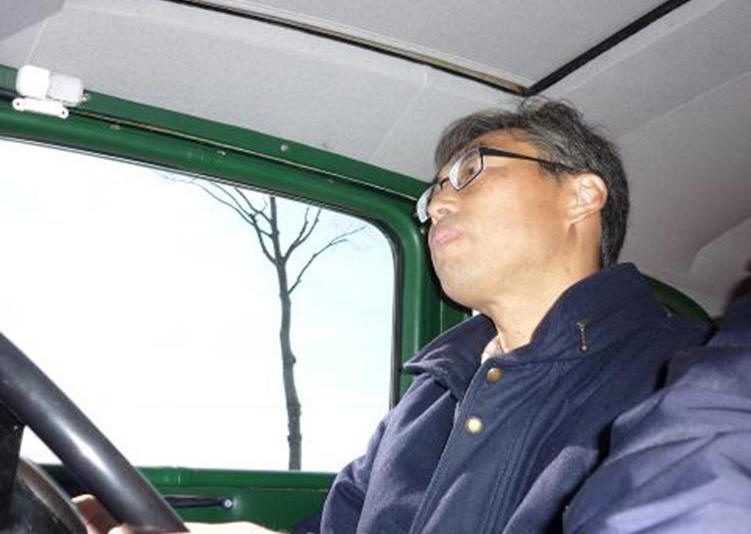
The three of us pile in, gaining the now so familiar gazes from passers
by, and its off to Ohmihachiman shrine for tea. A short drive brings us
to the temple area tea room, where we make our introductions. OK regards
his English as poor, but actually, he’s pretty good. Just as well
considering the standard or my Japanese. Sugimoto san is fluent: He’s a
19 year old architecture student with a Nippy in restoration and very
big plans. As is customary, I have taken a small gift – in this case, a
copy of Jonathan Woods’ book and one of Lorna’s CA7C badges. OK is
thrilled by this latter item: he has the CA7C sticker in the side window
but is bursting to fit the badge to the radiator, near his St
Christopher.
We take a tour around the temple, with OK very patiently explaining the
proper way to ritually cleanse your hands before entering. It’s just as
well that we hadn’t started anything too greasy at this point. It is a
very peaceful and beautiful place, made more so by the sharp winter
sunlight. OK has brought a camera and tripod, so group photos are a
must.
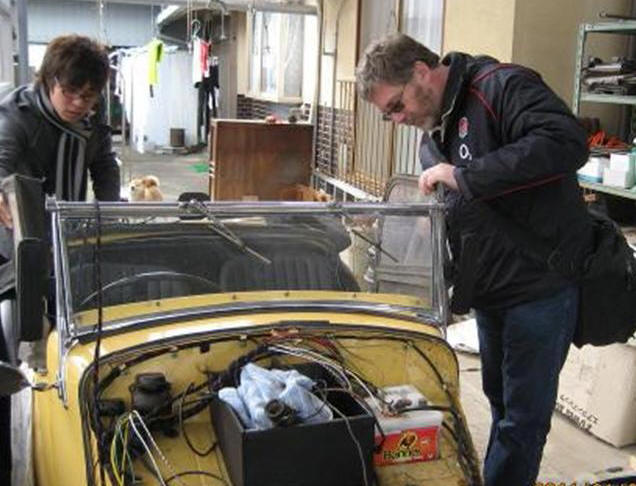 Next, we head to Hino city, to Sugimoto san’s grandfather’s house.
There, under a cover, is his Nippy. The bodywork is in very good
condition, but his major worry is the engine. It’s being treated to lots
of nice new parts and go faster goodies. In Japan, getting hold of Honda
pistons is Mundai Nai! (No problem!) I am barraged with questions, some
of which I can help with and others will take a little research. It’s
greasy time, so we grab a jack and a couple of blocks of wood, and the
Nippy is up in the air while we have a bit of a play with the Bowdenex.
They’ve got a bit gummed up over the years but after a bit of fiddling,
we breath life into the system. There’s a new wiring loom just fitted,
and some minor hinge rehanging on the cards, but Sugimoto san is
confident that he’ll get Nippy on the road later this year.
Next, we head to Hino city, to Sugimoto san’s grandfather’s house.
There, under a cover, is his Nippy. The bodywork is in very good
condition, but his major worry is the engine. It’s being treated to lots
of nice new parts and go faster goodies. In Japan, getting hold of Honda
pistons is Mundai Nai! (No problem!) I am barraged with questions, some
of which I can help with and others will take a little research. It’s
greasy time, so we grab a jack and a couple of blocks of wood, and the
Nippy is up in the air while we have a bit of a play with the Bowdenex.
They’ve got a bit gummed up over the years but after a bit of fiddling,
we breath life into the system. There’s a new wiring loom just fitted,
and some minor hinge rehanging on the cards, but Sugimoto san is
confident that he’ll get Nippy on the road later this year.
His sister is a bit more sceptical…
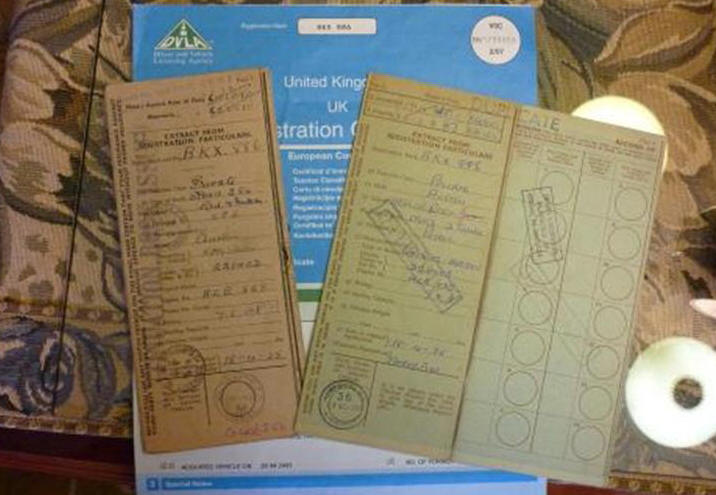 Over tea, he shows me what would be an interesting set of documents
anywhere in the world, but more so because of where he lives. There’s
the Green and Brown log books and the modern V5 all together. Many of us
don’t have all of them in the UK, so its great to see them together as a
set.
Over tea, he shows me what would be an interesting set of documents
anywhere in the world, but more so because of where he lives. There’s
the Green and Brown log books and the modern V5 all together. Many of us
don’t have all of them in the UK, so its great to see them together as a
set.
Its time to cover up the Nippy and head to our next stop. We visit an
ancient town of merchants, that formed one of what in the west would
become friendly societies. The Omian merchants believed in lots of
trade, low interest rates and reinvesting in society. All of this
when Britain was still very feudal. They made enough money to be
comfortable, and spent the rest on education. Many of the Omian
shops are unchanged to this day.
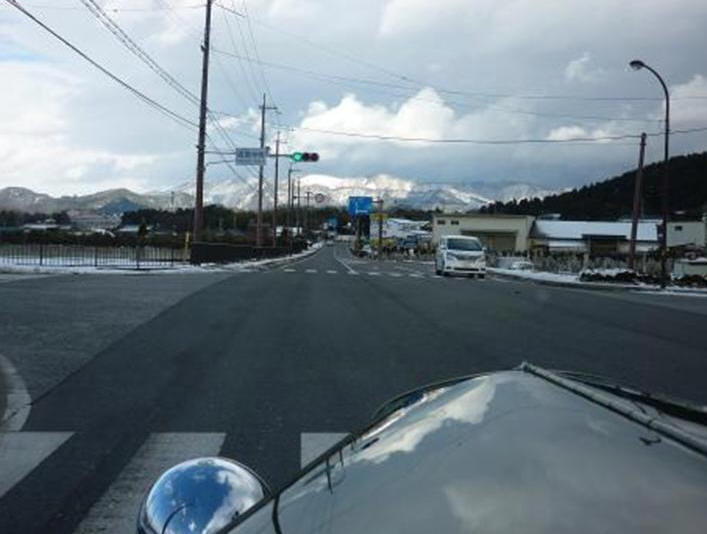 Back in the Ruby, we whizz off towards the mountains. The roads are wide
and gently winding, thankfully with not too much snow on the surface.
Three up, the Ruby keeps a good pace with the rest of the traffic,
bumbling at a nice 45mph. OK even adds to the mood with some hot ‘30s
jazz on his MP3 player. We grab a quick lunch of hot noodles in a café,
where the green and black curvy car looks so conspicuous in amongst the
angular, almost cubic “Kei” (city) cars from Honda, Daihatsu and Nissan.
Back in the Ruby, we whizz off towards the mountains. The roads are wide
and gently winding, thankfully with not too much snow on the surface.
Three up, the Ruby keeps a good pace with the rest of the traffic,
bumbling at a nice 45mph. OK even adds to the mood with some hot ‘30s
jazz on his MP3 player. We grab a quick lunch of hot noodles in a café,
where the green and black curvy car looks so conspicuous in amongst the
angular, almost cubic “Kei” (city) cars from Honda, Daihatsu and Nissan.
Our penultimate stop is the magnificent Hikoni Castle. Built on top of a
major earthwork in 1622, it features some of the most astounding joinery
in its construction. Rather than fuss about making straight beams, the
castle is constructed on a less wasteful approach of finding just the
right trees to interlock when assembled into a roof frame. No two beams
are the same, but they form a soft, interlocking jigsaw that today would
be featured on Channel 4’s Grand Designs.
The sun is beginning to set, so we round off our 70 mile trip. It’s back
to OK’s house for a final cup of tea before its time to leave for my
train. Here he springs a wonderful surprise. He’d mentioned that we
would take time to swap photographs, but instead he printed a set of
high quality photos and presented me with a stunning lacquered album,
decorated with a Samurai helmet on the front. Inside, there were maps of
where we had been, an itinerary, and places to keep my entrance tickets.
All too often, our digital pictures languish on a hard drive somewhere,
but this was such a generous keepsake.
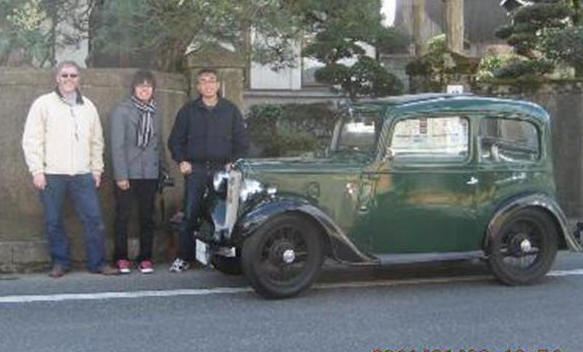 As the time to catch the train gets nearer, we drag ourselves away from
OK’s collection of motorbikes, and we’re back in the Ruby to go to the
station. It’s fully dark by now, and the Ruby springs its last surprise.
In Japan, it is considered polite to extinguish your headlights when
stationary at a junction. So OK has made a modification to the Ruby
wiring, so that the headlights are only on when the dynamo is charging.
As we slow down for a junction, they dim a little then settle to just
the warm glow of the sidelights. As we pull away, up they come like the
house lights at a theatre. For all you paranoids about having a slight
discharge on main beam, and worried about whether the battery might hold
up at night, this might be for you!
As the time to catch the train gets nearer, we drag ourselves away from
OK’s collection of motorbikes, and we’re back in the Ruby to go to the
station. It’s fully dark by now, and the Ruby springs its last surprise.
In Japan, it is considered polite to extinguish your headlights when
stationary at a junction. So OK has made a modification to the Ruby
wiring, so that the headlights are only on when the dynamo is charging.
As we slow down for a junction, they dim a little then settle to just
the warm glow of the sidelights. As we pull away, up they come like the
house lights at a theatre. For all you paranoids about having a slight
discharge on main beam, and worried about whether the battery might hold
up at night, this might be for you!
Back at the station, Sugimoto san and I take the express back to Osaka.
He steps off after a few stops, as the train drops him near his home. An
hour later, I’m back at my hotel having had a most excellent Austin
Sunday.
To OK san – my sincerest thanks for a really wonderful day.
This article, written by Geoff Hardman, originally appeared in Seven
Focus March 2011 pp22-27.