Last updated: 30th November 2024
Austin Big Seven Brochures & Advertisements
Motor manufacturers have always tried to outdo their competitors with new models, ever improving performance and specifications at an acceptable price for the target customer. Brochures available in the Dealer's showroom allowed the prospective purchaser to go home and think about the pros and cons and compare one manufacturer's car with another's model with similar specifications, features, and price.
Austin Motor Co Ltd Brochures
The Austin Motor Co. Ltd produced promotional brochures/leaflets from the very beginning. Competition in the small car market from Morris, Ford and Standard was very intense and the prospective buyer wanted the best value for money which for most working men in the 1910s/20s and 30s was very lacking. Those seeking to buy second-hand cars were also interested in specifications and indicated performance so collected a brochure from the Dealership.
Some of the brochures promoting the Big Seven are:
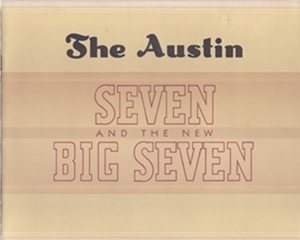
Pub 1539B from September 1937 announced the 4-door Big Seven as a roomy and comfortable car larger than the Ruby MK2. It also featured the Pearl Cabriolet, the Two-Seater and Open Road Tourer with their dimensions and mechanical specifications.
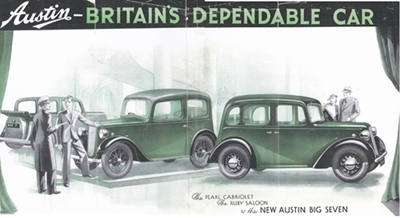
Pub 1543A was an unusually large, 15½” x 8½”, 6-page, green publication featured the ‘New Austin Big Seven’ with the Pearl Cabriolet, two-seat Open Road Tourer and Ruby Saloon giving the specifications—’Why you should Invest in an Austin’.
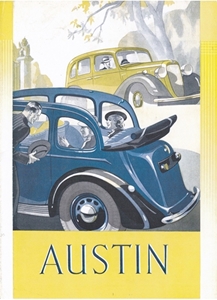
Pub 1578 covered Austin’s 23 models in the Ten, Twelve, Fourteen, Eighteen, Twenty, Delivery Vans, Ruby variants and Big Seven giving General Specifications and prices.
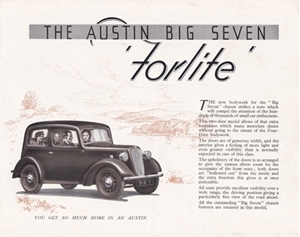
Pub 1647 was a single sheet of paper 19” x 7½” folded once and devoted to the key features of the Forlite, ease of access and roominess, and referred the reader to Pub 1539 for full specifications.
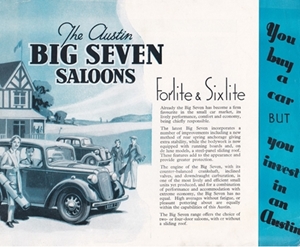
Pub 1677/2 was a single sheet of paper 27” X 7¾” folded twice with the strap line ‘You buy a car BUT you invest in an Austin’. It presented the key features and specifications of the Forlite & Sixlite.
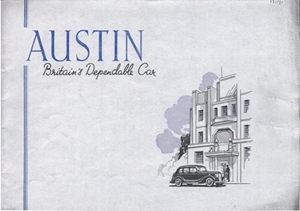
Pub 1738 introduced the Twenty-Eight Ranelagh in the increased range of 24 models, including the Sixlite and Forlite, with General Specifications and Standard Colours. Both Big Seven models were offered in Royal Blue, Maroon, Ash Grey, Princess Blue, Bluebird Blue and Black. The Fixed Head models were offered in Royal Blue, Maroon and Black only.
Austin Motor Co Ltd Advertisements.
Brochures were supported by advertisements placed in the motoring journals, Practical Motorist, The Autocar, The Light Car. This was the age when most owners had manual skills, maybe a close friend or family member who could help with the job in hand. The magazines carried articles to which diy owners referred when seeking guidance on maintaining and repairing their car. Articles were either general, in that they covered topics common to all makes of car, or articles specific to a make, and perhaps model.
The premium position was the front cover printed in full colour with an eye-catching photo effect drawing, a few facts, and the price.


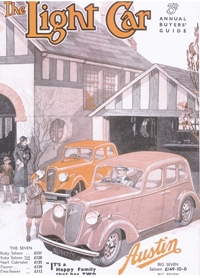

Other front cover advertisements had less colour, a 'catchy' statement and a photo effect image supported by a lot of text.
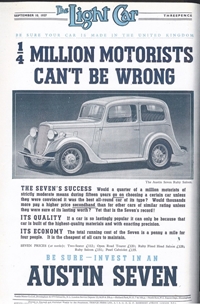

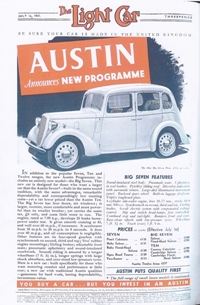

The second position for an advertisement was the back cover allowing for the chance of the magazine being placed face down on a table. These had less colour, an image of the model and text with price.d
Advertisements, usually b/w, were placed within the body of the magazines, sometimes alongside an editorial feature article of a model.
An advertisement must have immediate impact and so an ‘arrester’ word, or picture, is essential to attract attention of the reader quickly flicking through the pages. With the limited graphics, the use of colour and printing techniques of those times a larger, or different, font, often bold, was used for one stand-out word. The Company name sells, hence ‘AUSTIN’ but also ‘PERFORMANCE’; ECONOMY’; ‘SPEED’; ‘BIGNESS’; ‘‘POWER’ etc would catch the eye.
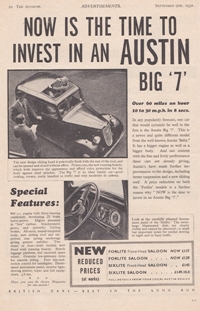
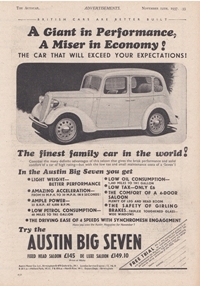
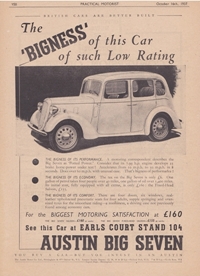
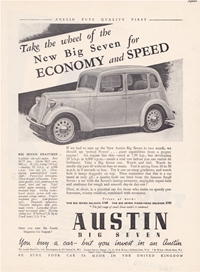
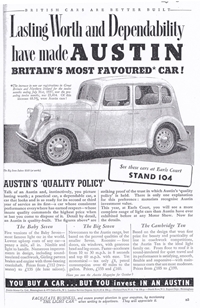
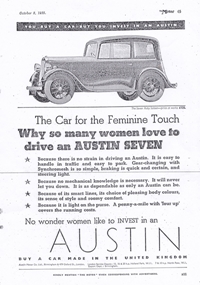
Earlier advertising campaigns with the Ruby had appealed to ‘the Feminine Touch’ and the number of motorists who had bought a Ruby.
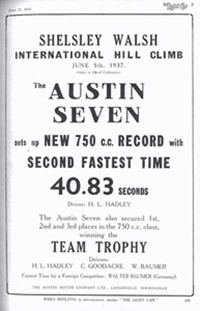
‘Motor racing improves the breed’ and the sport appealed to many people in the 1920s/30s and post WW2. Austin had a successful racing department largely based on the Seven participating in circuit races, sprints, hill-climbs, and endurance trials. The successes were the subject of many advertisements.
However, the best advertisement is personal recommendation and seeing so many cars of that make and model on the road . . . . I fancy one of those, I’ll get one!
This article was written by Doug Castle, a longtime 'Forlite' owner using material from his own collection. October 2023.